Why Sustainability Belongs at the Centre of Asset Management, not on its Margins
The real estate industry treats sustainability as a reporting obligation. That needs to change, because the investors who integrate sustainability into investment and risk decisions will outperform those who don’t.
The compliance trap
Most institutional real estate investors have spent the last five years building sustainability reporting capabilities. GRESB submissions are filed, CSRD disclosures are prepared, SFDR classifications are assigned, while BPS and benchmarking reports are produced.
And yet, in the vast majority of organisations, sustainability data still lives in a silo. It gets collected by the sustainability team, reported to regulators and benchmarks, and then shelved until next year. The fund managers making acquisition decisions rarely see it. The asset managers optimising operational performance don’t use it. The risk teams modelling portfolio exposure don’t have access to it in a usable format.
This is the compliance trap: organisations invest heavily in meeting regulatory requirements, but fail to use the data they’ve collected to make better investment decisions. The result is a sustainability programme that costs money but doesn’t create value.
Sustainability is an asset management imperative, not a reporting exercise
The framing matters. When sustainability is positioned as a compliance function, it gets resourced like one: minimal budget, small team, annual cadence. When it’s positioned as an asset management discipline, it becomes part of how organisations acquire, operate, and exit assets.
Consider what sustainability data actually tells you when you connect it to investment decisions:
Transition risk. Energy performance data, combined with CRREM decarbonisation pathways, reveals which assets face stranding risk under various climate scenarios. A building that looks financially healthy today may require €2M+ in capital expenditure within five years to remain lettable. That’s not a sustainability insight. That’s a financial risk that belongs in every asset review and hold/sell analysis.
Capex prioritisation. When you can model the emissions reduction, energy cost savings, and green premium impact of retrofit investments across a portfolio, you stop allocating capital based on gut feel and start allocating it based on ROI. The difference between a €50M capex programme guided by data and one guided by intuition is often 20–30% in efficiency.
Portfolio construction. Regulatory frameworks like the EU Taxonomy and SFDR Article 8/9 classifications are reshaping what qualifies as a ‘sustainable investment.’ Investors who can rapidly assess taxonomy alignment across their portfolio can rebalance proactively, rather than discovering misalignment during LP reporting.
Exit strategy. The green premium is real and growing. Assets with strong sustainability credentials, verified by data and benchmarks, command higher valuations and attract a wider buyer pool. The inverse is also true: assets with poor energy performance face a brown discount that will only widen as regulations tighten.
Why most organisations still get this wrong
If the case for integration is this clear, why hasn’t it happened? Three structural barriers explain most of the gap.
First, the data lives in the wrong systems. Sustainability data typically sits in specialised platforms or spreadsheets managed by the sustainability team. Investment data lives in portfolio management systems. Operational data lives in property management tools. Connecting these requires either manual effort (which doesn’t scale) or sustainability platform architecture that was designed for integration from the start.
Second, the sustainability team isn’t empowered to influence investment decisions. In most organisations, sustainability reports to a different part of the business than investment/asset management. The sustainability team can produce excellent reports, but they rarely have a seat at the table when acquisition, disposition, or capex decisions are made.
Third, the tools weren’t built for decision-makers. Most sustainability platforms were designed for sustainability professionals. The interfaces assume daily usage, deep domain knowledge, and a compliance-first mindset. Asset managers, who need sustainability insights quarterly or during deal evaluation, find these tools impenetrable. The result: they don’t use them.
What’s changing in 2026
Three forces: regulatory convergence, AI and investor expectations, are converging to make this the year sustainability integration accelerates.
Regulatory convergence is raising the bar. CSRD’s phased rollout means thousands of real estate entities will report under ESRS for the first time. Simultaneously, GRESB is evolving its methodology, SFDR requirements are under review, and the EPBD recast is pushing energy performance requirements across Europe. The volume and complexity of required disclosure is making it impossible to manage sustainability as a side project.
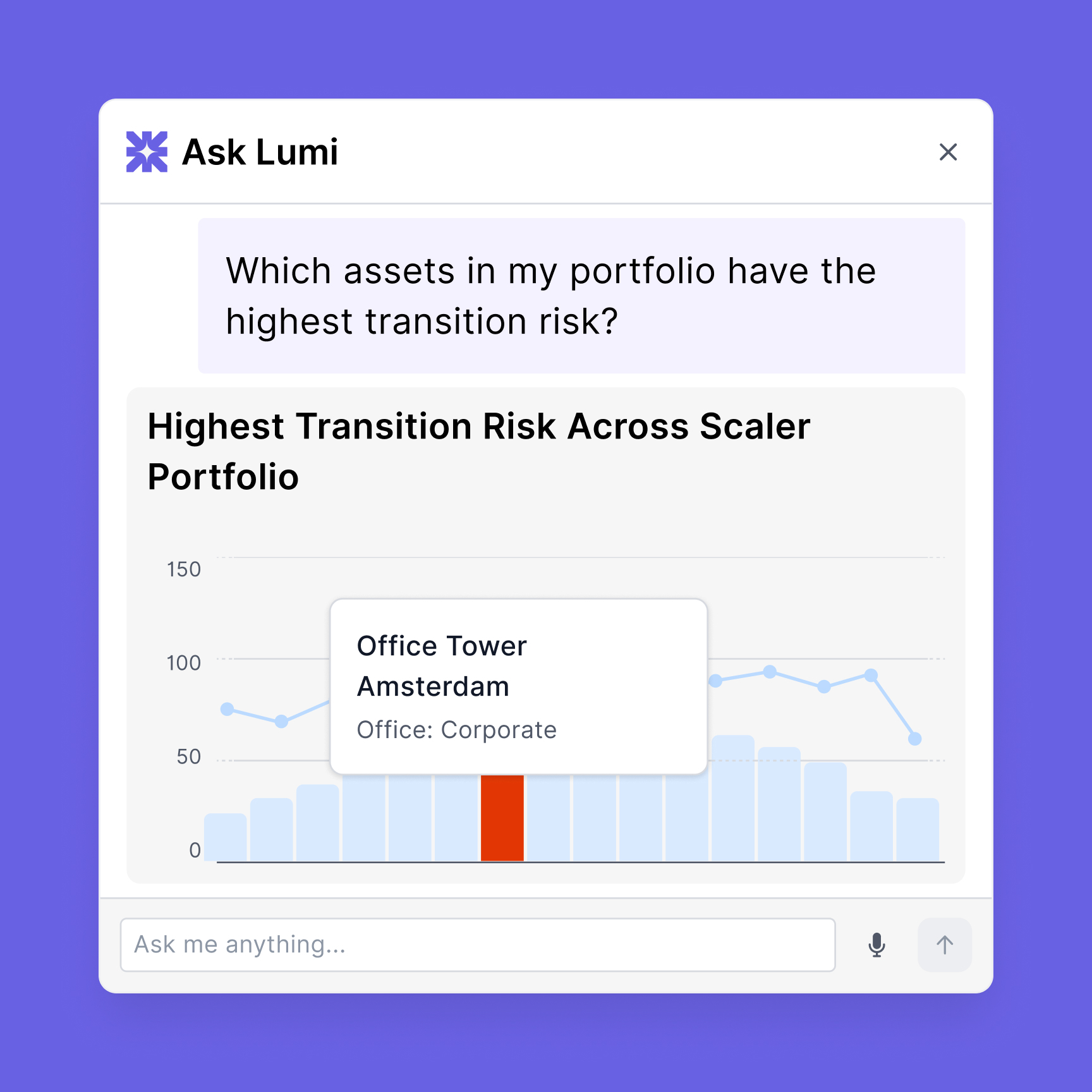
AI is making sustainability data accessible to non-specialists. Natural language interfaces and AI-driven analytics mean that an asset manager can now ask “Which assets in my portfolio have the highest transition risk?” and get an answer in seconds, without needing to understand CRREM methodology or navigate a sustainability dashboard. This is the unlock that breaks down the organisational silo.
At Scaler, this is exactly what we’re building with Lumi, our AI assistant. The goal isn’t to replace sustainability expertise. It’s to make sustainability insights available to everyone in the organisation who makes decisions that affect asset value.
Investor expectations are shifting from disclosure to performance. LPs and institutional allocators are moving beyond asking “Do you report on sustainability?” to asking “How does sustainability drive your risk-adjusted returns?” This shifts the value proposition from compliance (cost centre) to performance (value driver) and risk management (which assets are at risk of becoming stranded). Real estate investors who can demonstrate that sustainability data and physical and transition risk assessments inform their acquisition and asset management decisions have a material advantage in fundraising.
What sustainability-integrated asset management looks like in practice
The organisations getting this right share a few characteristics:
Sustainability data feeds into asset reviews, not just annual reports. Energy performance, emissions trajectories, regulatory exposure, and physical climate risk are part of every quarterly asset review, alongside financial performance and lease expiry profiles.
Capex planning is data-driven. Instead of allocating retrofit budgets based on which assets “feel” most urgent, leading investors model the financial and emissions impact of interventions across the portfolio, then prioritise based on risk-adjusted return.
Risk is quantified, not qualitative. Transition risk isn’t a red/amber/green rating in a sustainability report. It’s a financial exposure calculated from energy performance gaps, regulatory timelines, and market pricing data.
The whole organisation has access, not just the sustainability team. Asset managers, property managers, and investment committee members can each access the sustainability insights relevant to their role, in a format that matches how they work. And this extends to tenants, key stakeholders in sustainability performance, where structured engagement turns tenant data and feedback into actionable insight.
This is where platforms matter. Not as compliance tools, but as the connective tissue between sustainability data and investment decisions. At Scaler, our entire 2026 roadmap is built around this thesis: making sustainability data actionable for every stakeholder in the real estate investment chain, from the boiler room to the board room.
The cost of waiting
The real estate industry has a narrow window. Regulatory timelines are fixed. CRREM pathways don’t wait for organisational readiness. Assets that aren’t on a credible decarbonisation trajectory today will be harder to finance, harder to insure, and harder to sell tomorrow.
The organisations that treat 2026 as the year they move from sustainability reporting to sustainability-driven asset management will build a structural advantage that compounds over time. Better data leads to better decisions, which leads to better-performing assets, which leads to stronger fundraising, which funds more sustainable investment.
The organisations that wait will find themselves with accurate reports about a portfolio that’s losing value.
The question for every real estate investor reading this isn’t whether sustainability integration matters. It’s whether your organisation, your tools, and your processes are ready to make it happen.
Scaler is the sustainability data platform purpose-built for real estate investors. We automate data collection, reporting, and compliance, freeing teams to focus on what matters most: optimising assets and managing risk. Our platform combines financial, sustainability, and risk data with AI-powered analytics and asset roadmaps to reduce physical and transition risk across portfolios. To learn more, visit: